

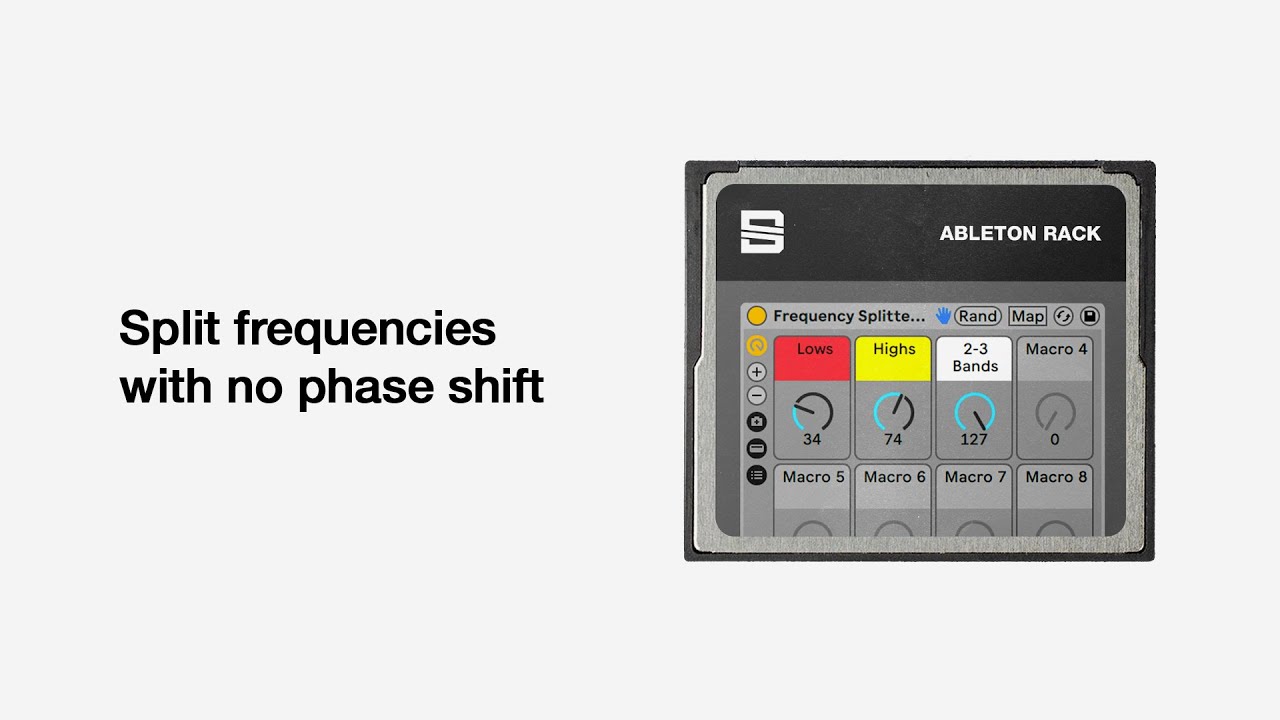

In this article, we are going to explore the ins and outs of the Linear Phase Frequency Splitter Rack in Ableton, a handy tool I’ve developed that will elevate your mixing game.
The Linear Phase Frequency Splitter Rack is a straightforward device. It’s neatly split into low, midrange, and high-frequency bands. This division allows you to effortlessly control and manipulate each frequency range separately, a key function when producing or mixing music.
In the rack, you can find crossover points within the midrange chain. This band is flanked by the lows and highs. The low frequencies are controlled with a low-pass filter, while the highs have a high-pass filter.
Interestingly, the mid-range is composed of the full frequency spectrum but with the lows and highs subtracted. To accomplish this, the lows and highs within the midrange chain are inverted in polarity. This approach avoids phase shifts, creating a clean and precise full spectrum in the mid-range.
As you can see in the video demonstration, the null test proves that there’s no difference between the two tracks.
This Rack is incredibly versatile, offering benefits for mixing, monitoring frequency ranges on your master bus, and even sound design. Worried about distortion and aliasing? With this Rack, you can simply apply it to the midrange, effectively protecting the high-end frequencies.
One of my favorite uses for this Rack is for monitoring the lows. By isolating the low frequencies, I can then use an oscilloscope to view the phase and assess the sidechain and the phase relationship, among other things. This lets me identify any issues and make accurate adjustments in the low-end frequency range.
Contrary to what you might expect from the name, the Linear Phase Frequency Splitter doesn’t actually have a linear phase as it doesn’t induce pre-ringing. Nonetheless, it provides an invaluable, phase-shift-free tool to enhance your music production and mixing.
This unique rack is available for free here.
Enjoy the advantages of precise frequency splitting and gain a better understanding of your sound.
I hope you find this tool as useful as I do!

